Real Estate Agents
The Hidden Mental Load of Being a Real Estate Agent
The Hidden Mental Load of Being a Real Estate Agent
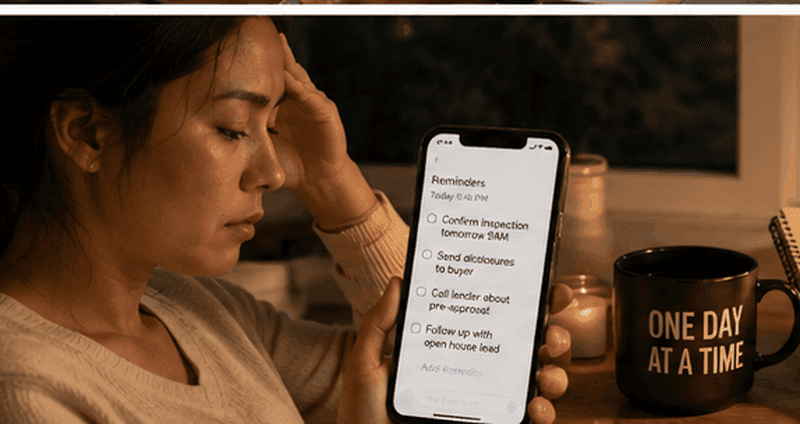
It is 7:12 at night.
You are home.
Technically, the workday is over.
Then your brain starts.
Did the seller sign the amendment?
What time is the inspection tomorrow?
Did I ever send that listing to Chris?
I need to remind the buyer about the wire instructions.
Did the photographer confirm Thursday?
I should call that open house lead.
You pick up your phone to check one thing.
Twenty minutes later, you are working again.
That is the part of real estate few people see.
The job does not always end when the appointments end.
The unfinished pieces follow you home.
Real estate agents carry a large amount of invisible work
There is the visible work.
Showings.
Listings.
Offers.
Closings.
Open houses.
Then there is the invisible work.
Remembering who needs what.
Watching deadlines.
Checking whether other people completed their part.
Preparing for conversations.
Following up.
Anticipating problems.
Keeping buyers calm.
Keeping sellers informed.
Trying not to forget anything that could affect the transaction.
That invisible work is one reason a day can feel exhausting even when there were only two appointments.
Every transaction creates open loops
A real estate transaction contains dozens of moments where something still needs to happen.
Waiting for signatures.
Waiting for inspection results.
Waiting for the lender.
Waiting for appraisal.
Waiting for title.
Waiting for the seller.
Waiting for the buyer.
Waiting does not feel like work.
But your brain may continue monitoring each item.
That is what creates mental clutter.
The solution is not remembering harder
Agents often develop mental habits around fear.
Do not forget the inspection.
Do not forget the call.
Do not forget the disclosure.
Do not forget to confirm tomorrow.
That anxiety can become the reminder system.
It works sometimes.
It is also exhausting.
A stronger approach is moving the commitment somewhere outside your head.
Remind me tomorrow at 8 AM to confirm the inspection.
Once the reminder exists, you no longer need to rehearse it all evening.
Why small tasks create so much stress
A task may only take two minutes.
Send the address.
Confirm the time.
Call the lender.
Text the seller.
But the brain does not measure tasks only by how long they take.
It also measures uncertainty.
Have I handled it?
When should I do it?
What happens if I forget?
Do I need to check again?
A two minute task with no system can create hours of background thought.
Create closure before leaving the car
One simple habit can reduce a surprising amount of mental carryover.
Before walking into the next appointment, capture whatever needs to happen after the current one.
You leave a listing appointment.
Remind me tonight at 7 PM to email Karen the pricing analysis.
You leave a showing.
Remind me at 5:30 to send Jason the disclosures.
A lender calls while you are driving.
When parked:
Remind me tomorrow at 9 AM to check on Lisa's approval letter.
Now those tasks are waiting somewhere other than your mind.
Use reminders for things you cannot act on yet
This is where reminders are especially useful.
Some tasks cannot be completed when you remember them.
The office is closed.
The client asked you to wait.
The paperwork has not arrived.
The listing does not go live until next week.
Instead of repeatedly remembering the task, decide when it should come back.
Remind me Monday morning to check whether the listing photos are uploaded.
That gives your brain permission to stop checking.
Separate reminders from calendar events
Your calendar should tell you where your time is committed.
Your reminders should tell you what needs your attention.
Those are different things.
A showing belongs on the calendar.
Calling the seller after the showing can be a reminder.
An inspection belongs on the calendar.
Asking the buyer whether they have questions afterward can be a reminder.
This keeps the calendar readable without losing the small actions surrounding each event.
Build a shutdown routine that takes five minutes
Before ending the day, ask four questions.
What must happen tomorrow?
Who am I waiting on?
Who is waiting on me?
What am I afraid I will forget?
Anything that appears in the last question deserves a reminder.
That final step can be the difference between carrying work into the evening and trusting that tomorrow has already been protected.
What The Pocket Assistant is useful for
The Pocket Assistant is not intended to become another complicated real estate dashboard.
It works best for the small commitments that appear throughout the day.
You text:
Remind me tomorrow at 9 AM to send the inspection report to Mark.
Or:
Remind me every Friday at 3 PM to review pending follow ups.
Or:
Remind me in 30 days to reconnect with the seller on Pine Street.
You receive the reminder later.
That is it.
For an agent already using several platforms, simplicity can be the feature.
Frequently Asked Questions
Why is being a real estate agent mentally exhausting?
Agents often manage unpredictable schedules, client emotions, deadlines, follow ups and several transactions simultaneously. Much of that workload involves remembering and monitoring rather than visible tasks.
How can real estate agents reduce mental load?
Move future commitments out of memory. Use calendars for appointments, a CRM for relationships and pipeline management, and reminders for time specific actions and follow ups.
How can real estate agents improve time management?
Reduce unnecessary task switching, capture commitments immediately, group similar work and assign specific times for follow ups and administrative tasks.
How do real estate agents stop thinking about work at night?
A short shutdown routine can help. Capture unfinished commitments, schedule anything that needs future attention and identify what can safely wait until tomorrow.
Final thought
You may never completely remove the mental load from real estate.
The job involves people, deadlines and uncertainty.
But you can stop asking your brain to be responsible for storing every unfinished piece.
The goal is not to remember more.
The goal is to have less that you need to remember.
Text it when it occurs to you.
Let it come back when you can actually do something about it.
Ready to stop forgetting?
Start your 10-day free trial. Set your first reminder in the next 5 minutes.
Start Free Trial →